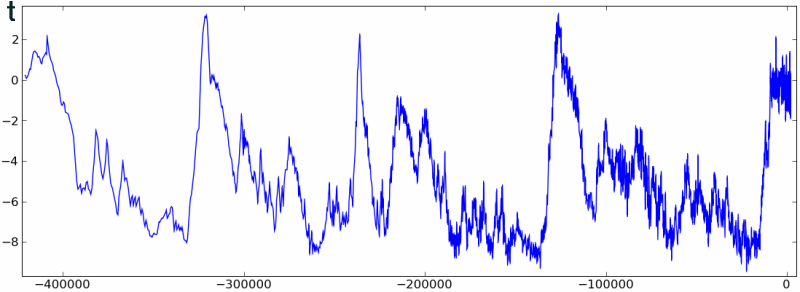
The current ice ageThe planet earth is currently in the middle of an ice age.At regular intervals polar ice caps expand, causing widespread glaciation and causing widespread devastation to the planet's ecosystems. This graph illustrates the temperature during the most recent glaciation cycles:
Recent global temperatures (from ice core data here) One thing is pretty obvious from this data - we are very near the end of the current interglacial period - and a new glacial cycle is imminent - indeed, probably overdue. Reglaciation would represent an apocalypse for life in the northern hemisphere - humans should be doing everything they possibly can to prevent this from happening. The current ice age has lasted 30 million years so far. Glaciation currently happens every 100,000 years on a very regular cycle. This graph illustrates the glaciation cycles:
Ten in the last million years - and they happen with considerable regularly.
The cause of glacial cyclesUntil relatively recently the preferred explanation for these cycles was [Milankovitch cycles ]. Milankovitch cycles are periodic variations the Earth's orbit, caused by factors such as precession of the elliptical orbit of the Earth, and changes of its axial tilt. However, this theory suffers from [many problems]. More recently some other theories invoking other astronomical effects have been developed.One theory is described in the document: Sun's fickle heart may leave us cold. The associated article is here: Solar resonant diffusion waves as a driver of terrestrial climate change [PDF]. The other theory involves changes to orbital inclination - an effect not understood in Milankovitch's day. This theory was pioneered by Richard Muller and Gordon MacDonald. The theory is summarised on Richard Muller's web site. Because of the problems with the Milankovitch cycle theory, these other theories may be preferable. Interglacial cycles are regular - but patyly because of the considerable uncertainty about the causes of interglacial cycles and the possible effect of human action on the climate, nobody really knows exactly when the current one is likely to come to an end.
The possibility of reglaciationWhatever the causes of the temperature cycles, we are currently in an interglacial period. However we are still in an ice age. If temperatues begin to drop again, large ice sheets will form. These will increase the Earth's reflectivity and reduce the absorption of solar radiation - creating positive feedback that leads to runaway cooling - and a catastrophic drop in global temperature.During glacial periods our planet is cold, dry, and inhospitable. Winters are longer and more severe. Few forests can survive but there are plenty of glaciers and deserts. Glaciers scrape up and pulverize vast stretches of land scraping off vegetation and topsoil and completely destroying entire ecosystems. In their wake they leave altered river courses, flattened landscapes, and piles of broken rock. Overall, an ice age is an abnormal and relatively-rare state of affairs. They are usually temporary and fleeting sicknesses for the planet. Details are here. Ending the ice age - if that is a practical possibility - would return the planet to its normal state.
Ending the ice ageIt should be obvious that ending the current ice age - and its regular cycles of glaciation - should be a matter of high priority. The current cycle of devastating glaciation must not be permitted to continue - since the cycles destroy a lot of the life on earth - and turn much of the planet into a frozen wasteland.If humans can successfully heat up the planet - and perhaps totally melt the ice caps - the next cycle of glaciation might conceivably be avoided - and we might successfully end the current ice age. Here is Freeman Dyson on the problem:
In each hundred-thousand year period, there is an ice-age that lasts about ninety thousand years and a warm interglacial period that lasts about ten thousand years. We are at present in a warm period that began twelve thousand years ago, so the onset of the next ice-age is overdue. If human activities were not disturbing the climate, a new ice-age might already have begun.
Ice age causesThe geological record appears to show that ice ages start when the continents are in positions which block or reduce the flow of warm water from the equator to the poles and thus allow ice sheets to form. If incoming solar radiation diminishes, ice sheets form. These increase the Earth's reflectivity and thus reduce the absorption of solar radiation. This creates positive feedback that leads to runaway cooling.Currently we have the continent of Antarctica sitting on top of one pole, and the the Arctic Ocean is almost land-locked - so circulation around both poles of the planet is restricted, preventing ice from encountering very much warmer water. This situation looks unlikely to change any time soon - and it is difficult to imagine us being able to do much to change it. The continents are still in a configuration where the earth is prone to glaciation.
Action planWhile oceanic circulation is challenging for humans to assist, other effects may be easier to control:
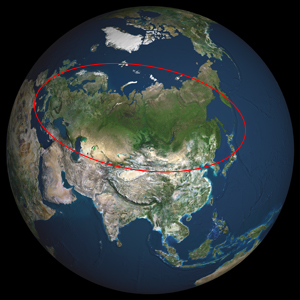
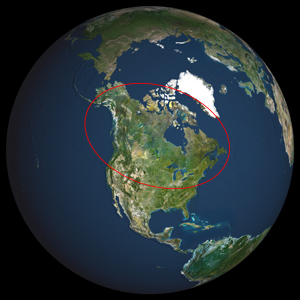
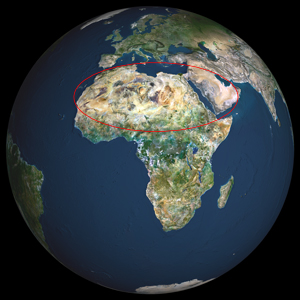
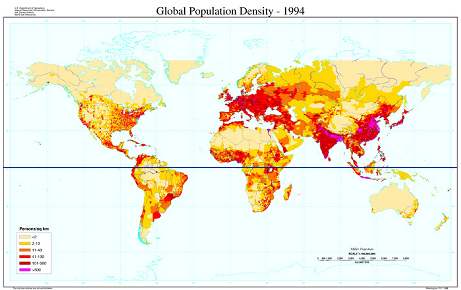
Frozen wastelandsObviously a warmer planet is highly desirable for other reasons - besides averting the global catastrophe that re-glaciation represents.Much of the continental land mass is concentrated around the poles. Russia, Europe, Canada, Greenland and Antarctica would all have their climate vastly improved if they were warmer. These regions contain large areas which represent potential environments for living systems but which are currently largely uninhabited, due to adverse temperature conditions. Run global warming scenarios backwards in time and you get a global catastrophe - where large, previously habitable areas of the planet are reduced to icy wastelands. Here are some of the areas that will benefit from global warming:
Most of the human population of the planet exists around the equatorial belt. Russia and Canada are largely uninhabited because their temperature is too low. Also, Saharan Africa is too dry - and would benefit from additional rainfall.
The equatorial region of the planet is mostly water. Oceans are mostly empty, inhospitable wastelands as far as living system go: nutrients all sink to the bottom - where there is no light - and on the surface there's nothing to eat. This distribution of land - where the land is concentrated around the poles - is actually what causes ice ages in the first place. Polar land masses prevent warm water from equatorial regions circulating around the frozen areas, and allow ice formed over the winter to persist over the summer - and thus accumulate.
Winter deathsCold kills. Here is Freeman Dyson on the topic:
There’s a lot made out of the people who died in heat waves. And there is no doubt that we have heat waves and people die. What they don’t say is actually five times as many people die of cold in winters as die of heat in summer. And it is also true that more of the warming happens in winter than in summer. So, if anything, it’s heavily favourable as far as that goes. It certainly saves more lives in winter than it costs in summer. Freeman Dyson is right about this. Heating the planet up a bit seems likely to save many lives.
Climate stabilityIce age climates are inherently unstable. That is because they are characterised by positive feedback - and are prone to flipping between extreme states. The cause of this positive feedback is the fact that ice and snow are white - and reflect incoming radiation back into space. This cools the planet, which in turn causes more ice and snow to form.When the planet is not locked in an ice age, its climate is more stable. That is because such eras are characterised by negative feedback. The cause of this negative feedback is the fact that any increases in temperature cause water to evaporate, which forms white clouds - which reflect incoming radiation back into space, which cools the planet down again.
Greening the desertsSaharan Africa is much too dry. Deserts are largely an ice-age phenomenon - for example, the Sahara desert formed during the current ice age. The main problem is lack of precipitation. A bigger greenhouse effect will heal the planet's deserts, and transform them into vibrant living ecosystems.This is already underway. The phenomenon is known as Global greening.
TimescaleThe warming process will inevitably be slow. It is estimated that it will take about a thousand years for the Greenland ice sheet to melt. Antarctic will probably take much longer. It is about -37 degrees C down at the pole, and the ice is an average of 2 kilometres thick. Because of the inevitable slow rate of progress, there will be plenty of time for living organisms to adapt to the changes.
ObjectionsFor some reason, certain factions seem to have got hold of the idea that warming the planet up is bad.They point to flooding, coral bleaching, forest fires and other problems as indications that change is undesirable. Warming the planet might have some side effects, it is true - but at least it helps avoid the devastating global catastrophe that re-glaciation would represent. It seems to me that many of these folk are luddites - who see the issue as a good excuse to place limits on industrialisation and growth. You might think environmental groups would be in favour of improving the habitability of the planet by getting rid of the parts of it that are uninhabitable frozen wastelands. You might think that they might regard CO2 as plant food - and would embrace plans to pump it into the atmosphere. However, they seem to be more interested in polar bears, bush fires and floods.
ProgressThis attitude raises the question of whether humanity is too stupid to see the problem - and will fail to take the required action to prevent reglaciation.I am optimistic about our chances. We probably have enough time to execute this plan, and - despite the protests of objectors - progress is now clearly being made. There is an evolutionary pressure to occupy vacant ecosystems. Now that life has become more adept at mastering technology, it is in a good postition to succeed. It seems likely that living systems will use their expertise to expand out of the equatorial band and colonise the rest of the planet, increasing the planetary albedo in the process, and tipping the planet away from its current frozen state. The likely outcome of all this is that [ocean reclamation] will take place - and most of the planet's surface will become covered with solar energy collectors - resulting in a significantly warmer planet, with fewer icy wastelands. Success will require increased efforts in these areas:
Accelerate Global WarmingSo far, progress has been rather slow.Slow progress leaves the planet close to the edge - and means that the climate is vulnerable to developing into another glacial era. For example, it is widely theorised that human efforts are already responsible for preventing another glacial period from starting. If humans are all that's keeping the planet from freezing, then catastrophic events - such as meteorite impacts or global warfare - may send the planet back into another glacial cycle - probably the last thing survivors will need. Because of these risks - and because the benefits of increased global temperatures are so great - an action plan is proposed to melt the ice caps - and more rapidly increase the safety and habitability of the planet. Having said that, some fear that the current changes are taking place too rapidly - and think we should slow progress in this area down, rather than speeding it up. I am inclined to think that the case for this is weak. Slowing down leaves the planet frozen for longer, and extends the duration of the period in which the climate is changing.
Questions
Real environmentalismThere are some real environmental issues out there which need addressing. The world badly needs proper irrigation. Heavy metals and other pollutants degrade the environment.I do not recommend wasting resources in a mostly-futile attempt to cool the planet down. That would put you on the side of those who want to drag the planet back into the dark ages. I do not recommend demonizing carbon either. Carbon dioxide is plant fuel. Plants thrive in CO2-rich atmospheres, grow faster, and absorb more CO2. Some horticulturists pump CO2 into greenhouses to encourage plant growth. Carbon is essential to all living things. Carbon dioxide is good. Carbon sequestration would be an idiotic move. The hysteria about global warming serves primarily to drain energy, funds and time from more important issues. Global warming is a bad cause. As such, it is mostly a destructive force. As with other types of religous zealotry, the supporters are typically well meaning, but misguided.
Isn't the ice age already over?No. The most recent glacial period has ended - but that's not usually the end of the ice age. Laymen sometimes refer to the glacial periods themselves as "ice ages" - but that is not how real scientists use the term.Whether humanity's efforts to heat the planet will prove sufficient to end the current ice age - despite the adverse continental positions - remains to be seen. One thing we can be pretty sure of: the costs of failing to end the ice age will dwarf any side effects of over-zealousness in attempting to prevent it.
In summaryWarming up the planet will represent a substantial engineering challenge. It may demand skills beyond our existing technological abilities. However, its importance is very great.Unless humans intervene on a dramatic scale and successfully end the current ice age, there is a large probability that the planet will shortly be plunged into yet another period of devastating glaciation, greatly reducing the planet's habitable zone, and destroying many living things. Once the planet enters another glaciation cycle, positive feedback effects mean that it will may be very difficult to extricate it. In order to avoid this fate - and to make the planet more habitable - we should work on heating up the planet now.
LinksDyson on Global warmingClimate of Fear: Why We Shouldn't Worry About Global Warming, by Thomas Gale Moore Harrison H. Schmitt and William Happer: In Defense of Carbon Dioxide The Greening of Planet Earth (1992) The Greening of Planet Earth Continues (1998) Global Warming: A Chilling Perspective Ice Age Now - "Not by Fire but by Ice" Climate Police Fossil-fuel hangover may block ice ages Global Warming and Nature's Thermostat - an article on clouds Global warming is goodWhy climate change is good for the world - Matt RidleyGlobal warming is good for you GLOBAL WARMING: A Boon to Humans and Other Animals - from 1995 'World doing just fine; Global Warming is Good; CO2 is our friend' say Scientists Glacier scientist: Global warming is good, not bad Retired professor turns whistleblower on climate change Love Global Warming - opinion piece Global warming 'is good and is not our fault' Global Warming a Boon for Greenland's Farmers Global warming will save millionsGlobal warming will save millions of livesGlobal greeningTyler, Tim Global greeningCO2 advocacyCO2 Science - Is carbon dioxide a harmful air pollutant, or is it an amazingly effective aerial fertilizer?CO2 is green - Claims that CO2 is a pollutant are a myth and are absolutely false Greening benefits Greening theory Carbon Dioxide - The Miracle of Food BooksClimate of fear: why we shouldn't worry about global warmingSuperFreakonomics Unstoppable Global Warming: Every 1,500 Years Meltdown: The Predictable Distortion of Global Warming by Scientists, Politicians, and the Media Climate of Extremes: Global Warming Science They Don't Want You to Know The Satanic Gases: Clearing the Air about Global Warming Relevant Wikipedia articlesIce ageTimeline of glaciation Five Myr Climate Change Milankovitch cycles Global warming Effects of global warming Mitigation of global warming Adaptation to global warming Carbon capture and storage Scientific opinion on climate change Global cooling - Concern in the mid-twentieth century TreesDo trees share blame for global warming?A climate model suggests that chopping down the Earth's trees would help fight global warming How Trees Might Not Be Green in Carbon Offsetting Debate More Trees, Less Global Warming, Right? - Not Exactly Gulf stream scareThe Source of Europe's Mild ClimateGulf Stream Will Not Shut Down, Science Magazines Admit No new ice age for western Europe Gulf Stream safe if wind blows and Earth turns The causes of ice ages - orbital inclination theoriesA New Theory of Glacial CyclesSpectrum of 100-kyr glacial cycle: Orbital inclination, not eccentricity - [PDF] Glacial Cycles and Astronomical Forcing - 1997 summary A brief introduction to ice age theories The ice ages and the Earth's climate Get Out Your Mittens The causes of ice ages - solar cycle theoriesSun's fickle heart may leave us cold.Solar resonant diffusion waves as a driver of terrestrial climate change [PDF]. The causes of ice ages - Milankovitch cyclesMilankovitch cyclesLong Debate Ended Over Cause, Demise Of Ice Ages? Research Into Earth's Wobble New Scientist 'climate myths'Climate myths: It's too cold where I live - warming will be greatClimate myths: Higher CO2 levels will boost plant growth and food production Climate myths: It's been far warmer in the past, what's the big deal? Global warming politicsGore's climate film has scientific errors - judgeGore and UN share Nobel peace prize |